Well this week we should be taking shipments of the Jeep from Zacuto, light weight 15mm rods from Element Technica and the Red Rock Micro Mattebox, which I'm dying to get my hands on. I'll be doing a video review of all of these items hopefully in the next few days after I get all of them in house. So far we've received the Micro Filters, the Zacuto Jeep, which I'll be using to bridge the 19mm Red One setup to my 15mm Mattebox, and we'll receive the rods tomorrow.
Look out for that video review coming in the next few days!
Wednesday, July 23, 2008

Monday, July 14, 2008
Red One...Audio?
This weekend I meet up with the owner of BD Pictures to help test out some issues that he is having with his Red Ones, most of which are audio problems. I was aware of some issues with the audio on the Red One, but I had figured that with the newer versions of the firmware that those issues had been resolved. Turns out that they haven't and that the audio issues with the Red One are one of the major issues. I had meet up with Ajay in Alameda with his two Red Ones and we set them up and swapped mics, enabled and disabled audio channels, and tried out phantom power all to find out that the Reds that he has do not do audio. There would be times where the audio level meters would come alive, but they would not sustain a signal. I guess with the Red you should always record your audio to an external DAT recorder in addition to the in camera audio recording just to make sure that you've got your audio. Yet another needed accessory to the Red One!
Another thing that we are going to try out is checking if the line level input on the XLRs works and that there might be issue with the Mic input and the pre-amps of the XLRs. Any ideas?
Another thing that we are going to try out is checking if the line level input on the XLRs works and that there might be issue with the Mic input and the pre-amps of the XLRs. Any ideas?
Wednesday, July 2, 2008
Red Rock Micro = Frustration
I got an email yesterday stating that the Red Rock Micro Mattebox was almost ready to ship and my heart started to dance, till I read the rest of the email. According to Red Rock Micro, the Mattebox is delayed again for another couple of weeks. There is a lot of talk online about the practice of vendors taking %100 payment on pre-order items which may or may not ship when they are said they will ship. This is another slip in a continuing trend with the Red Rock Micro Mattebox. Now I have to say that Red Rock has always been good at getting product out to me and responding to support and sales inquires.
So now we are all left to question, is the manufacturing and shipping delay what makes up the thousands of dollars in comparable product price difference and is it worth it? After spending $700 or so dollars on this product and not having it for two or so months after I paid for it is aggravating to say the least and the only thing Red Rock offered to offset the expense of time for their customers is an additional set of blue knobs.
The real question is will this cause customers to abandon the small companies like Red Rock that are trying to revolutionize the digital cinema market place? There are also delays with companies like Birger and View Factor that are also experiencing similar manufacturing issues. Seems like cheap parts and manufacturing comes at the expense of customers and time.
So now we are all left to question, is the manufacturing and shipping delay what makes up the thousands of dollars in comparable product price difference and is it worth it? After spending $700 or so dollars on this product and not having it for two or so months after I paid for it is aggravating to say the least and the only thing Red Rock offered to offset the expense of time for their customers is an additional set of blue knobs.
The real question is will this cause customers to abandon the small companies like Red Rock that are trying to revolutionize the digital cinema market place? There are also delays with companies like Birger and View Factor that are also experiencing similar manufacturing issues. Seems like cheap parts and manufacturing comes at the expense of customers and time.
Tuesday, June 3, 2008
RED One Purchasing
So I have an associate that it getting ready to film a feature length film and it trying to decide which camera to shoot the feature with. I obviously out of personal desire suggested that, if he was going to invest in his own equipment, to invest in a Red One package. One thing that people don't understand is that its not as easy as a $17,500 purchase because its not like buying a HVX200 or another pro-sumer camera. The Red One is a serious piece of professional equipment that is aimed at the profession cinema and commercial markets.
Yes the Red One is comparably cheap compared to other digital cinema cameras, but what people don't understand is it takes a lot of money to get a Red One working well. Some things people don't think of when they consider a Red One purchase are:
+ Rails
+ Follow Focus
+ Matte Box
+ Support
+ Post Production needs
+ Storage
+ Backup and Redundancy.
So over the last few months I've been trying to come up with a cost effective, yet production worthy Red One Package for my own use, and it come in two flavors, budget indie favorable, and regular indie favorable. Bottom line is it'll cost a filmmaker $50,000+ to get a good Red One setup. So here's my suggestion on a Budget Indie Red One Rig:
+ Red One Body - $17,500
+ Compact Flash Module - $500 (*A must for purchase)
+ Base Production Pack - $1,250
+ 5" LCD - $1,700
+ (2) Power Packs with 2 Chargers, 4 Batteries - $2,900
+ (2) Red Drive - $1,800
+ Nikon Mount - $500
+ Pelican 1620 - $190
+ Nikon Lens Set From RPLens.com (link) - $3500
+ Miller Arrow 55 Tripod and Head - $5,450 (* Weight of the camera needs a good head)
+ Lexar Compact Flash Card Reader - $75
+ Red Rock Micro Matte Box Red Bundle - $795
+ Tiffen DV Essentials Filter Kit - $440
+ Red Rock Micro Follow Focus - $795
+ Apple Mac Pro - $4,200 (*For editing and rendering)
+ Apple Mac Book Pro - $3,000 (* For Field off loads and backups)
+ Silverado Systems Field Master (Link) - $12,499.00
- G-Speed ES 4TB Raid (* For Data Storage)
- Sonnet Tempo eSata Card (* For Field Off Loads)
- Quantum LTO-3A Tape Drive (* For Data Archival)
+ Sonnet 640GB Fusion F2 - $800 (* For Field Off Loads)
So total price of this rig, which will be one stop shopping for production and editorial would be $57,854. Now you don't NEED all of this, but if its your intention to have everything you need to get started with a rig, this is a baseline of what I'd consider a full rig. Now its on the budget side since you don't have top end supports, matte boxes and follow focuses which can easily tack on thousands more per item.
You might be asking, "why do I need all this stuff?" Well here's an attempt at justifying things:
- Camera body is a must, everyone knows that.
- Compact Flash module is a must since Red won't sell a camera without one (it needed for firmware updates).
- Base Production Pack is a quick way to get handles, mounts, battery plates and rods for the Red One. Other options include items from Element Technica and other 3rd Party vendors.
- 5" LCD is lightweight and bright, but other options are Carrion LCDs but the difference in weight it a big deal when your skimping on a fluid head.
- Power packs, you need power, and you need redundancy. You don't NEED two charging units, but at minimum its advised to have at least 4 batteries for a day's worth of work and a unit to charge with.
- Red Drives, granted the Compact Flash option is great, but limits you to a few minutes of 4K footage per take. So a Red Drive gives you a lot more continuous minutes of footage for long takes. The reason for 2, redundancy on set.
- Nikon Mount is a must if you are looking to limit your budget with lenses. Granted you already have the PL mount and can rent cine lenses for a shoot, but you can own a set of lenses for half the cost of one PL lens from Red.
- Pelican 1620, a must. You're not going to store your $18,000 camera in a bag are you?
- Nikon lenses from PRLens.com is a good way to get a color matched, iris adjusted and focus pitched lenses in a set for half the price of one PL lens from Red. Will it be as good as Cine glass? No, but will it still be stunning, YES.
- Miller Arrow 55 tripod and head is one of the cheapest ways to go for a support system for the Red One. A Red One rig can get upwards to 35+ lbs. and you need a head and legs to support that weight without making camera moves look jerky and horrible. Other heads go for thousands more and do a better job, but this is the entry level!
- Lexar Compact Flash Card Reader - Good fast reader a must for CF recording.
- Red Rock Micro Matte Box is a good thing to have but its not a must. Since the camera is a cinema camera, you don't have build in ND filters so you need a filter holder. The Red Rock is the cheapest way to go for 19mm matte box that has plenty of filter holders. You can rent an Arri MB-20 for cheap at a daily rate also.
- Tiffen DV Essentials Filter Kit is a good cheap 4x4 intro set, but probably not up to the standards of DPs and Cinematographers who are professional based. Red Rock is also going to release a set of filters at a competitive price. This has a polarizer, ND and a UV.
- Red Rock Micro Follow Focus, again is another thing you can rent, but having a cheap Follow Focus on hand is always a good idea, and a follow focus is a MUST for a cinema camera. The Red doesn't have auto focus like an HVX.
- Apple Mac Pro with 8 cores is a must. If you plan on editing your 4K footage or 2K renders, you need a heft machine with tons of memory. Your old Mac isn't going to cut it, so invest in the latest and get it going. You'll also need Final Cut Pro and to ease things you might want to add a $3000 AJA Kona card to speed rendering.
- Apple Mac Book Pro is also a must for looking at footage on set, checking exposure and verifying the data coming off the drives. It also runs the backup drives and allows backing up on set to LTO and RAID.
- Silverado Systems Field Master is everything you need to store and backup Red 4K files on set with eSATA connections. It also includes LTO for archiving to 400GB tape drives and a 4TB RAID drive for keeping files. All of this in a Pelican case for easy and secure travel to and from set. A solution that is needed for any production. 4K files take up space and since it is digital, you don't want to lose your project to a hard drive failure.
- Sonnet 640GB Fusion F2 is another smaller drive for fast offloading on set. They can be RAIDed for redundancy and data security on set. Not totally needed, but good for having on set without taking along your master 4TB drives and risking your project.
Yes the Red One is comparably cheap compared to other digital cinema cameras, but what people don't understand is it takes a lot of money to get a Red One working well. Some things people don't think of when they consider a Red One purchase are:
+ Rails
+ Follow Focus
+ Matte Box
+ Support
+ Post Production needs
+ Storage
+ Backup and Redundancy.
So over the last few months I've been trying to come up with a cost effective, yet production worthy Red One Package for my own use, and it come in two flavors, budget indie favorable, and regular indie favorable. Bottom line is it'll cost a filmmaker $50,000+ to get a good Red One setup. So here's my suggestion on a Budget Indie Red One Rig:
+ Red One Body - $17,500
+ Compact Flash Module - $500 (*A must for purchase)
+ Base Production Pack - $1,250
+ 5" LCD - $1,700
+ (2) Power Packs with 2 Chargers, 4 Batteries - $2,900
+ (2) Red Drive - $1,800
+ Nikon Mount - $500
+ Pelican 1620 - $190
+ Nikon Lens Set From RPLens.com (link) - $3500
+ Miller Arrow 55 Tripod and Head - $5,450 (* Weight of the camera needs a good head)
+ Lexar Compact Flash Card Reader - $75
+ Red Rock Micro Matte Box Red Bundle - $795
+ Tiffen DV Essentials Filter Kit - $440
+ Red Rock Micro Follow Focus - $795
+ Apple Mac Pro - $4,200 (*For editing and rendering)
+ Apple Mac Book Pro - $3,000 (* For Field off loads and backups)
+ Silverado Systems Field Master (Link) - $12,499.00
- G-Speed ES 4TB Raid (* For Data Storage)
- Sonnet Tempo eSata Card (* For Field Off Loads)
- Quantum LTO-3A Tape Drive (* For Data Archival)
+ Sonnet 640GB Fusion F2 - $800 (* For Field Off Loads)
So total price of this rig, which will be one stop shopping for production and editorial would be $57,854. Now you don't NEED all of this, but if its your intention to have everything you need to get started with a rig, this is a baseline of what I'd consider a full rig. Now its on the budget side since you don't have top end supports, matte boxes and follow focuses which can easily tack on thousands more per item.
You might be asking, "why do I need all this stuff?" Well here's an attempt at justifying things:
- Camera body is a must, everyone knows that.
- Compact Flash module is a must since Red won't sell a camera without one (it needed for firmware updates).
- Base Production Pack is a quick way to get handles, mounts, battery plates and rods for the Red One. Other options include items from Element Technica and other 3rd Party vendors.
- 5" LCD is lightweight and bright, but other options are Carrion LCDs but the difference in weight it a big deal when your skimping on a fluid head.
- Power packs, you need power, and you need redundancy. You don't NEED two charging units, but at minimum its advised to have at least 4 batteries for a day's worth of work and a unit to charge with.
- Red Drives, granted the Compact Flash option is great, but limits you to a few minutes of 4K footage per take. So a Red Drive gives you a lot more continuous minutes of footage for long takes. The reason for 2, redundancy on set.
- Nikon Mount is a must if you are looking to limit your budget with lenses. Granted you already have the PL mount and can rent cine lenses for a shoot, but you can own a set of lenses for half the cost of one PL lens from Red.
- Pelican 1620, a must. You're not going to store your $18,000 camera in a bag are you?
- Nikon lenses from PRLens.com is a good way to get a color matched, iris adjusted and focus pitched lenses in a set for half the price of one PL lens from Red. Will it be as good as Cine glass? No, but will it still be stunning, YES.
- Miller Arrow 55 tripod and head is one of the cheapest ways to go for a support system for the Red One. A Red One rig can get upwards to 35+ lbs. and you need a head and legs to support that weight without making camera moves look jerky and horrible. Other heads go for thousands more and do a better job, but this is the entry level!
- Lexar Compact Flash Card Reader - Good fast reader a must for CF recording.
- Red Rock Micro Matte Box is a good thing to have but its not a must. Since the camera is a cinema camera, you don't have build in ND filters so you need a filter holder. The Red Rock is the cheapest way to go for 19mm matte box that has plenty of filter holders. You can rent an Arri MB-20 for cheap at a daily rate also.
- Tiffen DV Essentials Filter Kit is a good cheap 4x4 intro set, but probably not up to the standards of DPs and Cinematographers who are professional based. Red Rock is also going to release a set of filters at a competitive price. This has a polarizer, ND and a UV.
- Red Rock Micro Follow Focus, again is another thing you can rent, but having a cheap Follow Focus on hand is always a good idea, and a follow focus is a MUST for a cinema camera. The Red doesn't have auto focus like an HVX.
- Apple Mac Pro with 8 cores is a must. If you plan on editing your 4K footage or 2K renders, you need a heft machine with tons of memory. Your old Mac isn't going to cut it, so invest in the latest and get it going. You'll also need Final Cut Pro and to ease things you might want to add a $3000 AJA Kona card to speed rendering.
- Apple Mac Book Pro is also a must for looking at footage on set, checking exposure and verifying the data coming off the drives. It also runs the backup drives and allows backing up on set to LTO and RAID.
- Silverado Systems Field Master is everything you need to store and backup Red 4K files on set with eSATA connections. It also includes LTO for archiving to 400GB tape drives and a 4TB RAID drive for keeping files. All of this in a Pelican case for easy and secure travel to and from set. A solution that is needed for any production. 4K files take up space and since it is digital, you don't want to lose your project to a hard drive failure.
- Sonnet 640GB Fusion F2 is another smaller drive for fast offloading on set. They can be RAIDed for redundancy and data security on set. Not totally needed, but good for having on set without taking along your master 4TB drives and risking your project.
Tuesday, May 13, 2008
I Want To Make Movies - Now What? PT. 3
So my personal love in the film making world is the art of cinematography and camera operation. I love composition and the tech behind digital cinematography. One thing that originally drove me was the technological aspects of digital cinema. So when I started making movies it was obviously long before the advent of digital cinema, but my serious mature venture into digital cinema came when I realized that with a camcorder I could film, edit and distribute my film all with a camcorder, a mic, some lights and an Apple Computer. Now I know that you can edit on a Windows machine, but it didn't appeal to me quite like having a iMac DV with a Firewire port and iMovie.
I'd played with Premier on Windows prior to that point, but the Mac just seemed easier to get the footage into the computer, edited and outputted.
So where am I now with film making, cinematography and equipment? Well there are a number of things that can assist a new film maker in being able to achieve the most film like look from their low budget gear, but one thing is for sure, in order to get started it takes money.
So what would I suggest for the starting filmmaker? Here's a run down of gear and a price estimate as of the date of this post:
Ultra low budget:
Camera - Canon HV30 ($900)
Lights - Garage Can Sockets with daylight balanced 100W Halogen bulbs. ($50)
Moderate Low Budget:
Camera - Canon HV30 ($900)
Lights - Lowe Pro DV Kits ($600 - $1300)
Sound - Beachtek Adapter with a Azden Shotgun Mic ($200)
Support - Bogen / Manfrotto 501 Head and Legs ($500)
High Low Budget:
Camera - Canon HV30 ($900)
Lights - Lowe Pro DV Kits ($600 - $1300)
Sound - Beachtek Adapter with a Azden Shotgun Mic ($200)
35MM Adapter - Red Rock Micro M2 Adapter ($1745)
35MM Lenses - Nikon Set of 28mm, 50mm and 85mm ($1300)
Support - Bogen / Manfrotto 519 Head and Legs ($1300)
Of course as you get more and more sophisticated you spend more money. The current kings of indie cinema camcorders are the Panasonic HVX 200A and the Sony PWD-EX1, which both run for about $6000 and produce amazing images. The again there is a light on the horizon from Red Digital Cinema with their eagerly anticipated camera Scarlet which has 3K resolution (more twice the resolution as 1080P), 2/3" sensor which provides Depth of Field characteristics close to 16mm film, and tapeless RAW workflow which is leagues better than HDV and IMHO DVCPro due to the level of control it gives a person. All of this and more for HALF the price ($3000) of the current kings the HVX and the EX1.
In the next few blogs I'll try and explain the difference between DV, HDV, DVCPro, and RedCode RAW. When buying a camera its important to know the strengths and weaknesses of its native codec and what the codec buys or costs a filmmaker in post.
I'd played with Premier on Windows prior to that point, but the Mac just seemed easier to get the footage into the computer, edited and outputted.
So where am I now with film making, cinematography and equipment? Well there are a number of things that can assist a new film maker in being able to achieve the most film like look from their low budget gear, but one thing is for sure, in order to get started it takes money.
So what would I suggest for the starting filmmaker? Here's a run down of gear and a price estimate as of the date of this post:
Ultra low budget:
Camera - Canon HV30 ($900)
Lights - Garage Can Sockets with daylight balanced 100W Halogen bulbs. ($50)
Moderate Low Budget:
Camera - Canon HV30 ($900)
Lights - Lowe Pro DV Kits ($600 - $1300)
Sound - Beachtek Adapter with a Azden Shotgun Mic ($200)
Support - Bogen / Manfrotto 501 Head and Legs ($500)
High Low Budget:
Camera - Canon HV30 ($900)
Lights - Lowe Pro DV Kits ($600 - $1300)
Sound - Beachtek Adapter with a Azden Shotgun Mic ($200)
35MM Adapter - Red Rock Micro M2 Adapter ($1745)
35MM Lenses - Nikon Set of 28mm, 50mm and 85mm ($1300)
Support - Bogen / Manfrotto 519 Head and Legs ($1300)
Of course as you get more and more sophisticated you spend more money. The current kings of indie cinema camcorders are the Panasonic HVX 200A and the Sony PWD-EX1, which both run for about $6000 and produce amazing images. The again there is a light on the horizon from Red Digital Cinema with their eagerly anticipated camera Scarlet which has 3K resolution (more twice the resolution as 1080P), 2/3" sensor which provides Depth of Field characteristics close to 16mm film, and tapeless RAW workflow which is leagues better than HDV and IMHO DVCPro due to the level of control it gives a person. All of this and more for HALF the price ($3000) of the current kings the HVX and the EX1.
In the next few blogs I'll try and explain the difference between DV, HDV, DVCPro, and RedCode RAW. When buying a camera its important to know the strengths and weaknesses of its native codec and what the codec buys or costs a filmmaker in post.
Monday, May 5, 2008
Fotodiox Nikon to EOS adapter
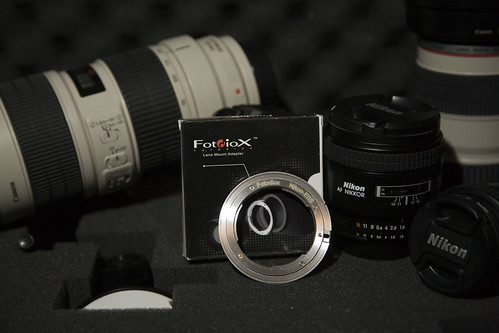
So I'm a professional photographer that has a good amount invested in Canon EOS lenses and cameras. For my digital cinema equipment I use Nikon lenses, mostly due to the manual aperture control, on my Red Rock Micro M2 rig, and in the future my Red One. When I purchased the Red Rock Micro M2, I purchased it with the EOS adapter AND the Nikon adapter, but since they have different flange focal lengths and different optics, you need to change out the mounts and the flange. So with all the work with that I changed my mount to a Nikon and haven't used the EOS mount since.
Now I want to use both my EOS Canon L lenses with my Nikon primes, so I went and purchased the Fotodiox Nikon to EOS adapter from Adorama. So now I'm able to add this adapter to my Nikon lenses and then attach the Nikon lens to a Canon EOS mount (like my 5D). The adapter is a small piece of metal that has a very small amount of metal to adjust the flange focus for a Nikon lens to a Canon flange distance.
My initial excitement about the ability to use my Nikon lenses on my Canon cameras and my Red Rock Micro M2 was quickly dashed after 2 minutes of attempting to work with the adapter. Now I already knew that with the adapter there would be NO AUTOMATIC CONTROL, but in a cinema environment, thats not really needed since manual is preferred. The issue with this adapter is attaching it to the Nikon lens is a pain! Its difficult to figure out where the alignment is going to go since the marker for matching up the mount to the adapter is hard to see. Once thats been found the attachment is so tight that its easy to move the aperture control without being aware of it. Also once the adapter is on the lens, changing the aperture is impossible with how it presses onto the lens.
With the adapter being so tight, I was almost scared when I thought about it getting permanently lodged onto the lens. Good thing is, once its on, it attaches to the EOS mount easily.
Now taking it off is another story. Just one suggestion, with the Fotodiox adapter, wear gloves when putting on the adapter and taking it off. The metal edges on the adapter are SHARP and make cuts in you fingers. Now I don't know if I got a bum adapter, but after attempting to get the adapter off of the lens I had numerous cuts in my thumb and forefinger. Also, in order to free the lens from the adapter you have to pull up on a tiny metal tab and twist the adapter free from the lens. Not an easy task and you risk putting your grubby fingers on the rear element of the lens.
Good thing about this adapter it its cheap. There are $255 adapters for sale (Novoflex) that might have a better build quality and easier usage, but this one is $50. In the end they work the same, but the cut fingers and frustration are difficult to justify.
Pros: Ability to attach Nikon F Mount lenses to an Canon EOS camera or mount. Price at almost a third the cost of the other adapters.
Cons: Hard to mount to lens. Difficult to remove from lens. Sharp metal pieces cut fingers. Taking adapter on and off lenses not good for the life of the lens.
Suggested: No. I don't know about the Novoflex adapter, but I'm sure its another case of you get what you pay for.
Busy weekend
This weekend was a busy one, not leaving much time for blogging. Tonight I should have a blog up with a review of a Nikon to Canon mount adapter I purchased for attaching Nikon lenses to my Red Rock Micro Canon EOS mount so I have a wider array of lenses to choose from without changing the flange focus of the M2 adapter. Plus I should be a week or so away from receiving my Red Rock Micro Mattebox which I'm planning on doing a full video unboxing of and posting here! Should be good!
Look for that review tonight and hopefully another segment of "I want to make movies, now what?"
Look for that review tonight and hopefully another segment of "I want to make movies, now what?"
Subscribe to:
Comments (Atom)